What Is a Freebie Funnel? (Beginner-Friendly Guide to Lead Magnet Automation)
There are tons of ways to grow your email list, but offering something valuable for free is hands down the fastest.
But creating your freebie is only half the battle. You can make the best checklist or template or guide in the world, but if you just put it out there and rely on the “build it and they will come” idea, you'll probably be waiting a while.
That's where your freebie funnel comes in.
Quick clarification before we dive in: This post is about setting up the funnel for your freebie, not about creating the actual freebie itself. If you're still in the “what should my freebie even be?” phase, you'll want to start there first.
What is a freebie funnel?
A freebie funnel is a simple system that captures email addresses in exchange for something valuable (like a checklist, template, or guide). It consists of three core pieces: an opt-in page where people sign up, a thank you page that confirms and guides them, and email delivery with follow-up that builds the relationship. It's where your relationship with future customers begins.
Affiliate Disclosure: This post contains affiliate links, which means I may earn a small commission (at no extra cost to you) if you choose to purchase through them. I only recommend products and services from people I know personally and that I genuinely believe will help you build your business.
Table of Contents
What Is a Freebie Funnel, Anyway?
In the simplest terms, a freebie funnel is a system that captures email addresses in exchange for something valuable. But it's also so much more than that.
It's where your relationship with your subscribers actually begins. It's your chance to show up, deliver value, and prove you're worth paying attention to.
Even though freebies don't generate direct revenue, they're one of the most valuable pieces of your business because they're building your audience of future customers.
Your freebie (also called a lead magnet) should solve a small but real problem for your audience. Not their entire life. Just one specific thing that makes them go, “Oh thank god, I needed this.”
You're not collecting emails just to have a big number in your email platform. You're building relationships with people who will read your content, reply to your emails, and hopefully, eventually buy from you.
A freebie funnel gives you a direct line to them on your terms, not at the mercy of whatever algorithm is having a bad day.
Not sure what a freebie funnel is?
Read What Is a Freebie Funnel? first to get the foundation.
Then come back here to learn what mistakes to avoid.
Why This Actually Matters
Here's what a good freebie funnel does for your business:
- Builds relationships with future customers, not just random people who might ignore you forever
- Turns casual readers and viewers from your blog, YouTube, or Pinterest into people who actually care what you have to say
- Establishes trust by delivering real value upfront, so when you eventually sell something, they already know you're legit
Speaking of building trust and eventually making sales, if you want to understand how to connect the dots between list building and actually selling, grab my free guide: The 5 Core Elements of a High-Converting Sales Page. It pairs nicely with funnel work and will help you see the bigger picture.
How a Freebie Funnel Works
Here's the basic flow, no fancy jargon required:
- You share a free resource that solves a clear problem
- You ask for an email address in return (fair trade)
- You deliver that resource by email right away
- You follow up to help them actually use it
- You keep showing up with value, and over time, they start to trust you
That's it. Nothing complicated. Just a clear promise, an easy way to get it, and then actually following through.
A solid freebie funnel does three things well:
- Gets attention with a crystal-clear promise (not vague “ultimate guide” nonsense)
- Removes friction so signing up feels safe and simple
- Delivers on the promise, then continues to add value with helpful follow-up

This is the foundation that supports every other funnel you'll ever build. Skip this part, and you're basically pouring water into a bucket with a hole in the bottom. Not ideal.
Why Your Funnel Needs to Look and Feel Like YOU
People only hand over their email when they feel safe and confident in what they're getting. Your funnel should sound like you, look like your brand, and deliver on exactly what you promised.
When you give serious value for free, you earn trust fast. That trust is what eventually turns a subscriber into a customer. The fastest way to burn that trust? Being vague, taking forever to deliver, or immediately hitting them with a sales pitch.
The fastest way to build it? Clear messaging, fast delivery, and genuinely helpful follow-up.
A few ways to build trust from the start:
- Be specific about what your freebie offers and who it helps (your freebie should be specifically aimed at your ideal customer, not anyone and everyone who happens across it)
- Put your audience's needs first (not your need to make a sale right this second)
- Actually follow through on every promise, including the small stuff like delivery timing
This is the beginning of your customer journey. Make it a good first impression.
A quick note about the platform I use: I run my entire business on Subtrio, an all-in-one platform that handles email, funnels, websites, CRM, and more.
It's saved me from juggling six different tools, and the support is genuinely incredible—private community, weekly office hours, fast help desk responses, and tons of templates to get you started.
Check it out if tech overwhelm is getting you down or you're tired of duct taping your business together.
The 3 Essential Pieces Every Freebie Funnel Needs
Every freebie funnel has three core parts. You don't need anything else to start. Seriously. Skip all the fancy extras for now. Nail these three pieces first, then add more later if you want.
1. Your Opt-In Page: The Welcome Mat
Your opt-in page is where people land after clicking a link in your YouTube description, blog post, Pinterest pin, or wherever else you're promoting your freebie.
Think of it as your welcome mat. It should be simple, focused, and immediately clear about what they're getting and how it helps them.
What to include:
- A clear headline that states the benefit (not just “Free Checklist” but what the checklist actually does for them)
- A short description that sets expectations without rambling
- A simple form with minimal fields—usually just name and email
- A strong call to action like “Send Me The Guide” so the next step is obvious
If someone can't figure out what they're getting within five seconds of landing on your page, they're not signing up. Clarity beats clever every single time.
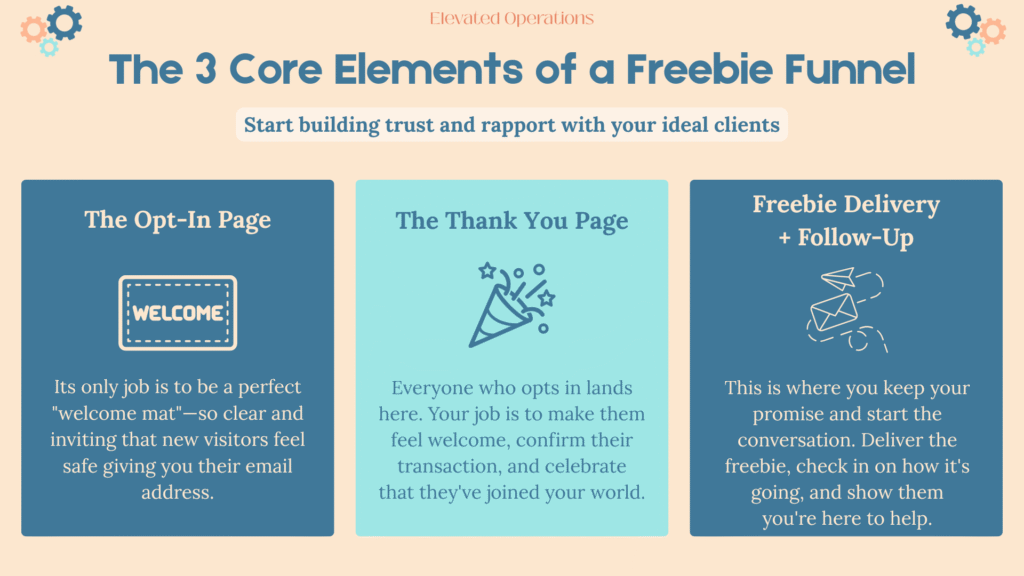
2. Your Thank You Page: Prime Real Estate You Shouldn't Ignore
After someone hits submit, they land on your thank you page. This page can be an afterthought for some, but don't take it for granted.
This is your chance to welcome new subscribers, set expectations, and guide them toward something helpful while they're still excited and engaged.
What to include:
- A warm thank you that acknowledges they just took action (people like feeling good about decisions)
- A reminder to check their email for the freebie
- A clear next step because they're already here and looking for direction
Helpful next steps could include:
- Inviting them to your Facebook group or community
- Pointing them to your YouTube channel for related content
- Linking to a few related blog posts they might find useful
Your goal here is to stay top of mind and keep being helpful. They already trust you enough to give you their email, so act like a good host and show them around.
Bonus points if you do this in video form.
3. Email Delivery and Follow-Up: Actually Seal the Deal
Deliver the freebie by email immediately. Not in an hour. Not “within 24 hours.” Right away. If you promised something, send it fast.
Then, follow up. Not with fluff or random chatter. With actual help. Be the guide who helps them get a result from what you just gave them.
A simple follow-up sequence:
- Email 1: Deliver the freebie (obviously) and set expectations (keep this email short)
- Email 2: Share quick tips to get the most out of the freebie (send within a day or two)
- Email 3: Check in to see how it's going and invite them to reply
You don't need fancy upsells or complicated automations at this stage. You can add those later if you want. For now, just deliver, support, and build trust.
If they are a new subscriber, from here you should send them to a welcome sequence that tells them more about you and your philosophies and then put some offers in front of them.
If you need help with your email game, I highly recommend my friend and coach, Pam Allen. She has email strategy and templates inside her Template Treehouse membership.
A Few Quick Tips to Make Your Funnel Work Even Better
Once you've got the basics set up, here are some simple tweaks that make a real difference:
Keep your promise front and center. If your freebie solves a problem in 10 minutes, say that. Be specific.
Reduce friction. Ask for as little information as possible, and make absolutely sure your form works on mobile. (More people browse on their phones than you think.)
Send your delivery email fast. If it takes hours, you lose momentum and people start forgetting why they signed up in the first place.
Add a quick “whitelist” note. Something like “Drag this email to Primary so you don't miss anything” helps with deliverability.
Mention your freebie inside relevant content. Don't just stick it in your sidebar and hope people notice. Weave it into blog posts and videos where it actually makes sense.
Track one metric at a time. Start with your landing page conversion rate. Before you mess with anything else, improve your copy and clarity first.
What About Common Mistakes?
I see the same freebie funnel mistakes over and over, so I wrote a whole post breaking them down (and how to fix them). If you want to skip the learning curve and get it right the first time, check out Common Freebie Funnel Mistakes (And What To Do Instead).
For now, just focus on getting these three core pieces in place. The biggest mistake you can make right now is overthinking this and never actually launching. Done beats perfect every time.
Bringing It All Together
A freebie funnel works because it's simple.
Offer real value. Make signing up safe and clear. Deliver fast. Keep helping.
That's how trust grows. That's how casual readers become subscribers. That's how subscribers eventually become customers.
To start, you just need the three core pieces—an opt-in page, a thank you page, and a few solid emails—and the commitment to actually follow through.
Start with that. Build momentum. Then layer on the fancy stuff later if you want it.
Your move.
Key Takeaways
A freebie funnel is the foundation for growing your email list and building relationships with future customers.
The three essential pieces are your opt-in page (where people sign up), your thank you page (where you set expectations and guide them), and your email sequence (where you deliver and follow up). Get these three pieces right, and you'll turn casual visitors into engaged subscribers who actually want to hear from you.
Now go build that fabulous freebie funnel.
Want ongoing support while you build your funnels?
Join the Elevated Funnels Club for templates, training, live office hours, and a
community of creators learning to build alongside you.

Hey Everyone! I’m Jess
I love to help female entrepreneurs build sales funnels without the tech overwhelm. I believe in keeping things simple, testing what matters, and skipping the stuff that doesn't.